Frequently
asked questions
Below are some of the most frequently asked questions regarding
Interpump pumps, their selection and installation. We trust these
will answer some of your questions but don't hesitate to contact
us regarding any further assistance or advice we can provide.
1. What is a positive displacement piston pump?
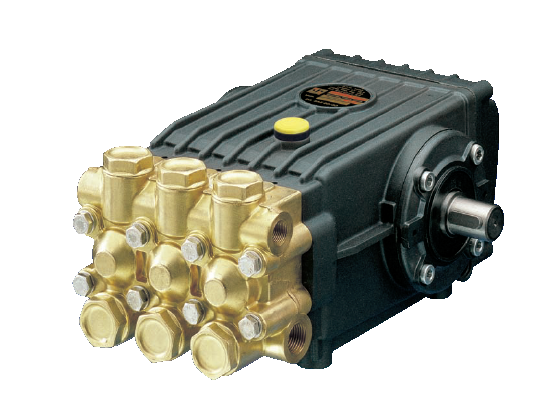
A positive displacement piston pump is a pump equipped with one
or more pistons (usually 3 or 6), where the flow rate (liters or
gallons per minute) is directly proportional to the rotation speed
(r.p.m.). From 1977 the pumps designed and manufactured by Interpump
have incorporated innovative design solutions that have become models
for manufacturers of these types of pumps around the world. These
innovations include:
- Double seals on each plunger with a low pressure intermediate
chamber to keep the water seals cool and lubricated, this system
also permits any leakage to recirculate back to the pump inlet.
- Synthesized pistons of super-hard ceramic.
- Connecting rods of special alloys with a low attrition coefficient,
high wear resistance and high anti-seize properties.
- A hydraulic structure designed to simplify scheduled maintenance
procedures (gasket and valve replacement).
During construction the main components manufactured at Interpump's
factories are subject to the rigid controls that conform with ISO
9001 (the company has been certified since 1993) and all finished
products undergo a 100% inspection process.
2. What are the major applications for piston pumps?
Piston pumps are convenient in applications where high pressure
is a basic requirement. This makes them virtually irreplaceable
in certain sectors such as:
a) High-pressure cleaning
b) Petrol and chemical industry
c) Paper mills
d) Mills
e) Reverse osmosis for water desalination
f) Construction sites
g) High pressure cutting
h) Air conditioning (cooling and humidification)
i) Tool cooling on lathes, work centers, etc.
j) Hydro-sandblasting
k) Agriculture, crop-dusting
3. What liquids can be pumped?
Interpump pumps have been designed and manufactured to utilize clean,
non-salt water at ambient temperatures. However, other types of
liquids can be pumped as the experience of customers shows. Generally,
for water-based solutions the pH level must be between 4 and 11
(in any case, when dealing with levels 4 and 11, please contact
us). If the water includes abrasive particles (sand, shavings, etc.)
a 20-30 micron grade filter must be installed. The pumps are prepared
to pump water up to a temperature of 65°C but for these applications,
the pump must be fed a minimum pressure of 1 bar as read from the
suction line, for some models a kit is available for higher temperatures.
In this case, please contact us. Please note that the pumps have
not been designed to include the necessary requisites for pumping
potentially hazardous liquids (explosive, toxic or inflammable).
4. What criteria should be used for selecting a pump?
Selecting the appropriate pump from our product line normally depends
on the flow rate and pressure requirements of the specific application
so by using the paired volume/pressure critera it will generally
be possible to find a model with the right specifications. If you
require any assistance please don't hesitate to contact us. Please
note that the pressure level given in the catalogue is the maximum
level at which the pump may be used and that there are no restrictions
on using the pump at lower pressures. The indicated flow rate is
obtained when the pump is running at the rated speed (r.p.m.) as
the flow rate is directly proportional to pump speed and can be
changed by varyng the r.p.m. The values given in the catalog may
be reduced (within a certain limit), but not increased. Also included
under the pump specifications is the rating of the motor that will
be required as this indicates the power required from the motor
when the pump is utilized at the rate specifications (pressure,
flow rate, r.p.m.) given in the catalogue. If the pump is used at
a lower rating, the motor power must be recalculated (see point
#5).
5. How is motor power determined ?
The rating given in the catalog is that required by the
pump to operate at the maximum levels given. For coupling to electric
motors, their power must be greater than or equal to that given
in the catalogue. For coupling to petrol engines, their power must
be at least 30% higher than that indicated (nA curve). In the event
a specific application requires a flow rate and/or pressure other
than those given in the catalogue the motor power can be recalculated
using the the following formula:

where:
HP = absorbed power (in HP)
Q = flow rate (in l/min)
P = pressure (in bar)
385 = coefficient
To couple the pump to a petrol engine, take this result and increase
the power by 30% as described above.
6. What else is needed to complete the installation?
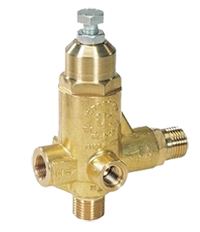
The pump must be equipped with a safety valve or regulating valve
that may be automatic. The safety valve is installed on the pump
and adjusted (normally 10% over the maximum allowable pressure)
to discharge the entire flow whenever the maximum set level is exceeded
for whatever reason. The pressure regulating valve (which may be
automatic), regulates the pressure by releasing any excess liquid
delivered to maintain the the correct pressure. In some applications,
for reasons of safety, both valve types (safety and regulating)
may have to be installed. In order to monitor the pressure, a gauge
with scale adequate to the operating pressure must also be installed.The
Interpump catalogue includes a wide range of regulating, automatic
and safety valves, as well as a number of accessories for high pressure
cleaning (lances, guns, fixed and rotating nozzle heads, etc.) as
well as accessories (couplings, flanges, pulleys and gear reducers)
that have been developed to facilitate the most common types of
pump/motor couplings.
7. Pump installation?
For the correct pump installation, follow these instructions:
Hydraulic connections:
- Using the appropriate piping, connect the pump inlet and outlet
as shown:
- The diameter of the inlet pipe must be greater than or equal
to the diameter of the pump inlet port and must be straight and
as short as possible (a few meters long, at most). It must either
incline up or down towards the pump and any connections that could
create air pockets must be avoided. Avoid installing components
that could cause restrictions on the inlet line. Even if the water
is clean, a filter with a filtering level of 350 micron or less
must be installed on the inlet line, it must have a greater capacity
than the flow rate of the pump and it must be cleaned periodically.
- All pipes, hoses and accessories connected to the pump outlet
must be adequate for pressure levels greater than or equal to the
pressure set for the safety valve and/or regulating valve.
- The pump may be fed under pressure directly from the water mains
with a maximum pressure of 10 bar. If the pump intake is from a
tank, it is preferable that the water level be above the pump or
at the same level. If the water is sucked up from below the pump,
the difference in level must not be greater than 3m for pumps up
to 1750 revs/min and 1m for those at a faster speed, in this case
the water must be at ambient temperature. Problems with priming,
vibrations or excess noise are all symptoms of poor water supply
and could cause serious damage to the pump. If any of these symptoms
appear, we suggest that the pump be stopped immediately and the
water supply connection checked.
Mechanical installation:
- Using the Interpump flanges, couplings and gear reducers that
are available for a range of models ensures correct connections
due to the accuracy in the machining of the components. With this
type of coupling, take care to fix the motor to the base of the
unit (using rails or silent blocks if needed), leaving the pump
free.
- If the pump is driven with belts and pulleys, pay special attention
to pulley alignment and belt tension (to do this, the pump must
be assembled on a special belt-tightener slide with adjusting screws).
Please note that if the belts are too tight, the oil could overheat
and reduce bearing life. For more information on pulley and belt
size, please refer to the technical specifications supplied by the
manufacturer of the transmission belts.
- Direct coupling using a flexible joint without a flange is more
difficult. In this case, both the pump and motor are attached to
the unit base and before connecting the pump to the motor the two
shafts must be perfectly aligned, if necessary using spacers under
the feet of the pump or motor. The purpose of this is to avoid pressure
on the pump and motor bearings. If the pump has been coupled using
the joint, or belts and pulleys, all exposed moving parts must be
protected with joint or belt guards.
|